
There is a certain stillness that settles over a house the moment before a journey begins. The bags are packed, the taxi idles outside in the gray morning mist, and the weight of leaving presses softly against the chest. In many cultures, this moment brings a flurry of anxious hurry, a frantic check for passports and tickets. Yet in the Irish tradition, this threshold is sacred. It’s the moment where a voice, often weathered by time and love, whispers an Irish Travel Blessing.
It’s far more than a simple “goodbye” or a quick “be safe.” Rather, it’s a spiritual embroidery, weaving protection into the very fabric of the road ahead. Understanding these blessings means understanding a landscape where the mist meets the mountain, and where the spiritual realm feels just as real as the earth underfoot. They are ancient verbal amulets, handed down through many generations, bridging the gap between those who stay and those who go.
What Is the True Meaning of an Irish Travel Blessing?
On the surface, an Irish Travel Blessing seems like a simple poem or prayer for someone heading off on a trip. However, that definition is far too thin to capture its beating heart. In the Gaelic way of thinking, traveling was never just a geographical shift from point A to point B. Instead, it was a passage through uncertain elements, a crossing of thin places where the veil between the physical and spiritual worlds grew almost transparent. Because of this, the meaning behind these blessings isn’t simply about wishful thinking. It is about true invocation.
A genuine traditional Irish blessing calls upon the deepest forces of nature—not as vague ideas, but as living, breathing companions. The prayer doesn’t just ask for the absence of harm. On the contrary, it asks for the active presence of God, of nature, and of the ancestors. When you speak or receive a Celtic travel prayer, you are taking part in a sacred contract of care. The speaker steps into the role of a spiritual shield-bearer, and the words become a traveling companion that will not abandon the traveler.
The core meaning is rooted in a theology of walking together. In ancient Celtic spirituality, the journey of life was rarely walked alone. Christ was seen as a close companion on the road, not a distant judge. To say an Irish blessing for journey is to physically wrap the traveler in a cloak of spiritual and meteorological comfort, ensuring the path rises to meet them, not to strike them down. It’s a deeply practical form of magic, born from a rugged island life where a sudden weather change on a cliffside road could mean death.
Core Elements of an Irish Travel Blessing
| Element | Meaning | Modern Application |
|---|---|---|
| The Road | Support and welcome from the earth itself | Safe passage on highways, flights, or walking paths |
| The Wind | Divine propulsion and favorable circumstances | Smooth travels without resistance or delay |
| The Sun | Warmth, joy, and divine recognition | Emotional comfort and spiritual clarity |
| The Rain | Gentle nourishment and provision | Material needs met during the journey |
| God’s Hand | Complete protection and belonging | A sense of being held, no matter the distance |
Carved in Mist and Stone: The Celtic Roots of the Blessing
To truly grasp the weight of the Irish Travel Blessing, we must step back into a time long before the printed word, into the Bronze Age mists of the Celts. The Celts held a spirituality that was immanent—Gods were not confined to the sky; they whispered in the rushing stream, roared in the western wind, and warmed the bones through the sun. This animistic worldview shaped a very unique Christian conversion in Ireland. Unlike the Roman model, which often stripped away local customs, the Celtic Church draped the new faith over the old architecture. The saints became the new druids, and the sacred wells became baptismal fonts.
This blending gave birth to the lorica tradition—a prayer of protection, often called a “breastplate prayer.” The most famous is St. Patrick’s Breastplate, an incantation calling upon the strength of the heavens, the sun’s brightness, and the stability of the earth. As a direct descendant of this lorica tradition, the Irish Travel Blessing acts as a miniaturized armor of faith, designed specifically for the vulnerabilities of movement. When you look at a Gaelic blessing, you aren’t reading a Hallmark card. You’re peering into a mind that firmly believed words could shape reality.
The oral tradition was the very bloodstream of these prayers. In the flickering light of turf fires on long winter evenings, the seanchaí (storyteller) and the village elders would pass down these rhythmic protections. They were living texts, flexing to fit the specific peril of the era—be it a voyage across a storm-thrashed sea to America during the Famine, or a walking pilgrimage to Croagh Patrick. The history of the ancient Irish prayers is a history of a people who understood that life is a fragile pilgrimage, and words are the strongest bridges we can build under our feet.
Timeline: The Evolution of Irish Travel Blessings
- Pre-Christian Era (Before 400 AD): Druidic oral charms for safe passage through dangerous terrain
- Early Christian Period (400-800 AD): Syncretism of pagan nature reverence with Christian faith; birth of the lorica tradition
- Medieval Period (800-1500 AD): Monastic preservation of blessings in illuminated manuscripts
- Famine Era (1845-1852): Blessings become essential farewells during mass emigration
- 20th Century: Global spread through diaspora communities and popular culture
- 21st Century: Digital sharing on social media; use in secular and interfaith contexts
The Landscape of the Lyric: Dissecting Ireland’s Most Famous Travel Blessing
No discussion of this tradition is complete without immersing ourselves in the actual poetry. So, let’s look at the undisputed champion of the genre, a verse that has circled the globe more times than any Irish emigrant.
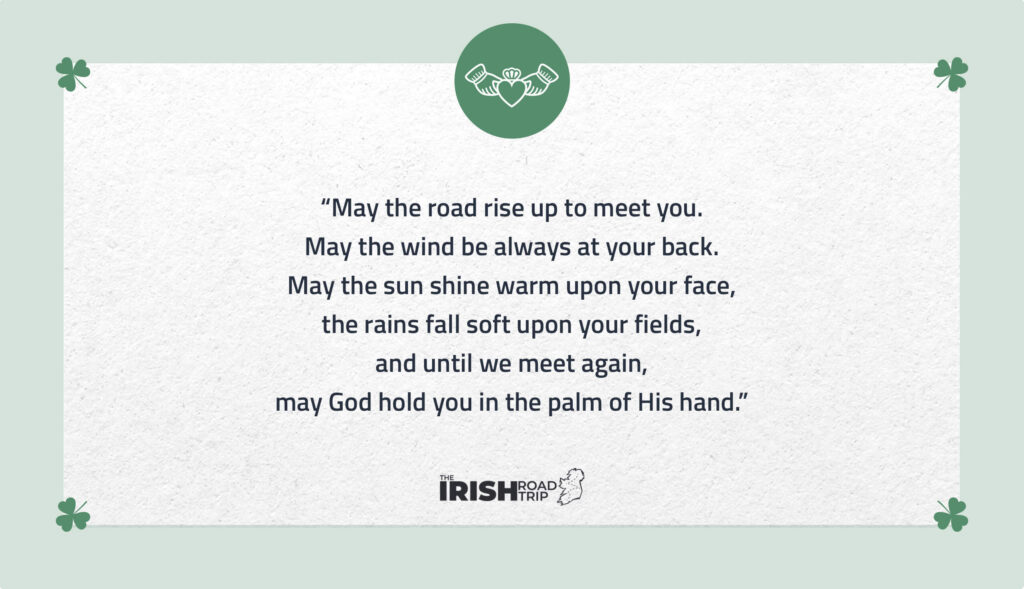
May the road rise up to meet you.
And the wind be always at your back.
May the sun shine warm upon your face;
the rains fall soft upon your fields
and until we meet again,
may God hold you in the palm of His hand.
This is the standard-bearer, the quintessential traditional Irish blessing. But its very ubiquity has dulled our capacity to feel its weight. Let’s unpack what it is actually saying, piece by piece.
“May the road rise up to meet you” is not a prayer for a flat, effortless motorway. A road that rises to meet you, in the physical landscape of the Irish west, is one that supports your every step. It’s a prayer against stumbling, a wish for cushioned strides on challenging terrain. The “wind always at your back” is a literal request for helpful currents, pushing you homeward and sparing you the grim, full-frontal battering of an Atlantic squall.
The balance between “sun upon your face” and “rains upon your fields” is a masterclass in equilibrium. It’s a prayer for personal joy through the sun on the skin, and for material provision through the rain for the crops back home. It asks for happiness and sustainability. Finally, the closing line—”the hollow of God’s hand”—evokes an image of total safety, a nest within the infinite. It is a profound Celtic travel prayer.
Lesser-Known Gems of the Gaelic Tradition
Yet there are other, sharper-edged gems in the treasure chest of Gaelic blessings. Consider the rhythm of this older safe travels prayer Ireland once murmured by the hearth:
A thousand welcomes to meet you,
A thousand angels to greet you,
A thousand bridges beneath you,
No evil to defeat you.
Here, the triple repetition of “a thousand” acts as a binding seal against the dark. “Bridges beneath you” starkly acknowledges that every journey contains chasms, both literal and psychic. These aren’t just pleasant goodbyes; they are emergency kits for the soul, crafted with a high-fidelity understanding of human anxiety. According to a thoughtful reflection on the power of these ancient words, they carry a presence into a loved one’s life even if the person isn’t aware of it initially. They plant seeds of grace that can bloom in a time of crisis.
Collection of Irish Travel Blessings: A Quick Reference
| Blessing Name | First Line or Key Phrase | Best Used For |
|---|---|---|
| The Classic Travel Blessing | “May the road rise up to meet you…” | Any journey, farewell gatherings |
| The Thousandfold Prayer | “A thousand welcomes to meet you…” | Long-distance moves, emigration |
| St. Patrick’s Breastplate | “Christ be with me, Christ within me…” | Spiritual warfare, major life transitions |
| The Fisherman’s Prayer | “Dear God, be good to me…” | Sea travel, risky ventures |
| The Homecoming Blessing | “May you always have walls for the winds…” | Welcoming someone back |
The Unseen Companion: Spiritual Protection on the Path
Why do we feel a shiver of transcendence when reading an Irish Travel Blessing? The Irish landscape is simply drenched in the numinous. The land itself is a layered manuscript of holy wells, ring forts, and mass rocks, places where the veil is said to be perilously thin. Traversing such a charged environment historically required more than a packed lunch; it required serious Irish spiritual protection.
The spiritual significance lies in the belief in the “pilgrim soul.” In the Celtic Christian framework, we are all homo viator—man on the way. The physical journey directly mimics the interior spiritual quest. Therefore, a blessing for a flight to Boston is, simultaneously, a prayer for the destination of one’s soul. A Celtic travel prayer combats the ancient, primal fear of the void. The unknown road was a hostile wilderness where fairies (Aos Sí) could lead you astray, or where despair could whisper louder than hope.
The Shield of the Spoken Word
When a father pressed his thumb to a son’s forehead, reciting a Gaelic blessing, he was mapping the Trinity onto the traveler’s imagination. The travel blessing functions as a spiritual container, drawing a circle around the person and insisting that chaos and anxiety remain outside. Furthermore, it transforms the arbitrary hostility of nature into a willing ally. It is a theological claim that the world is, at its core, hospitable, held together by a hand that will not let us slip. In this context, a “blessing” is not a vague vibe—it is a tactical deployment of grace. Ultimately, it’s a way of ensuring the traveler remains within the caim—the encircling invisible shield of divine safety—long after the physical voice of the sender fades out of earshot.
Sacred Thresholds: When and Why We Invoke the Blessing
The Irish Travel Blessing was never a one-size-fits-all cliché; instead, it was a liturgically porous tool. Specific rhythms in life demanded these words.
Historically, the most heart-rending application was the departure for emigration. The “American Wake” was a cultural phenomenon in which families gathered to say goodbye to a son or daughter they knew they would likely never see again this side of heaven. The recitation of a traditional Irish blessing in that crowded room was not polite small talk. It was a dirge and a resurrection shout mingled into one, the last breath of home the emigrant would carry across the Atlantic.
When to Use an Irish Travel Blessing
- Air travel: Calming nerves before a flight
- Road trips: Starting a long drive with intention
- Moving abroad: Saying farewell to loved ones
- Medical journeys: Traveling for treatment or healing
- Pilgrimages: Sacred journeys to holy sites
- Daily commutes: Transforming routine into ritual
- Virtual send-offs: Sharing via text or social media
Daily Life and Sacred Pilgrimage
Beyond the epic sorrow of emigration, people used these blessings for a variety of profound moments. For instance, a fisherman pushing out his currach would often say a simple prayer, the sea spray mixing with holy water, as a brief Celtic travel prayer acted as insurance against the deep. Likewise, walking barefoot to Station Island or climbing Máméan required a spiritual readying of the feet, making the blessing a preparation for sacrifice. Additionally, as a person lay dying, the “journey” into the next world was the ultimate trip, and the Irish blessing for journey held the soul steady during this final migration. Even a sudden squall on a footpath called for an improvised, breathless safe travels prayer Ireland.
We use these blessings today because abstract “good luck” doesn’t satisfy the soul’s hunger for security. And need the poetry. And need to feel linked to ancestors who also trembled before stepping onto a ship or a horse-drawn cart. When we offer a Gaelic blessing today, we are elevating the mundane GPS-guided trip back into the realm of the epic. It sacralizes the M6 motorway.
The Celtic Tongue and the Global Voice: How Irish Blessings Stand Apart
Place an Irish Travel Blessing alongside a travel prayer from another culture, and the differences become starkly revealing. Comparative analysis isn’t about proving superiority; rather, it’s about understanding texture. A typical American evangelical prayer for travel might be direct and propositional: “Lord, we ask for a hedge of protection around this vehicle.” It is fortress-centric.
Contrast this with the Celtic approach. The Irish don’t just build a fortress; they befriend the landscape outside the walls. In an Irish Travel Blessing, the sun is not a heat source to endure; it is a “warm welcome on the face.” The road is not a potential flat-tire hazard; it is a conscious entity that “rises up.” The wind is not a threat to stability; instead, it is a propulsion system pushing you forward.
Comparison: Irish Blessings vs. Other Cultural Travel Prayers
| Culture | Style | Focus | Example Phrase |
|---|---|---|---|
| Irish Celtic | Elemental, poetic | Harmony with nature and God | “May the wind be always at your back” |
| American Evangelical | Direct, protective | Spiritual warfare and safety | “Place a hedge of protection around them” |
| Latin American Catholic | Intercessory | Saints and angels accompanying | “Vaya con Dios, que los ángeles te guíen” |
| Buddhist | Meditative, karmic | Universal loving-kindness | “May you be free from harm and suffering” |
| Jewish | Scriptural, communal | God’s guardianship | “May the Lord guard your going and coming” |
Eastern Mysticism and Latin Brevity
Eastern traditions share something of the poetic reach but differ in agency. A Buddhist metta (loving-kindness) meditation for a traveler might project energy, wishing them to be “free from danger and well and happy.” It relies on the universal flow of karma and intention. The Celtic Christian blessing, while deeply mystical, is explicitly personal. It names God (Dia) and evokes the intimacy of a palm holding the universe.
The Latin “Vaya con Dios” (Go with God) is a close cousin, but it lacks the elemental character. The Irish genius lies in the synthesis. The Celtic travel prayer refuses to divorce the Creator from creation. You don’t just get God; you get God’s wind, God’s sun, and God’s road. As detailed in a comprehensive guide to traveling in prayer, it’s about inviting the Divine Keeper into every moment of the journey, combating the anxiety that lurks at the edge of the map. It’s a theology of embrace, not of escape.
The Digital Cloak: Modern Evolution of an Ancient Rite
The Irish Travel Blessing has not been fossilized in a museum display of folklore. On the contrary, it has shape-shifted, adapting brilliantly to the 21st-century digital diaspora. It remains a vital, throbbing pulse of Irish identity, though the medium has shifted dramatically.
Modern Formats for Irish Travel Blessings
- Social media graphics: Stylized text over Irish landscape photos
- Digital greeting cards: E-cards sent before trips
- Voice notes: Recorded blessings shared via messaging apps
- Video messages: Short clips with spoken blessings
- Phone wallpapers: Blessing text saved as lock screen images
- Podcast sign-offs: Used by Irish-content creators
- Email signatures: Blessing lines added to personal emails
The Social Media Send-off
Scroll through Instagram or Facebook before a friend’s long-haul flight, and you’ll likely see a beautifully designed graphic of the “May the road rise” text, superimposed over a shot of the Cliffs of Moher. The Irish Travel Blessing has become a staple of digital well-wishing, a way of saying “I care” with a depth that an emoji simply cannot convey. For the modern Irish person, posting this is a secular act of cultural pride; for the diaspora, it’s a DNA activation, a connection to roots they may have never physically touched.
Gifts and Keepsakes
The commercial world has latched onto this power, yet it often does so with a genuine sense of reverence. It’s rare to find an Irish gift shop lacking pendants, plaques, or pocket tokens inscribed with a Gaelic blessing. These artifacts serve as tangible anchors. A father lacing a bookmark with the Irish blessing for journey into a daughter’s gap-year backpack is recreating the ancient lorica ritual. It’s a physical touchstone that can be held during turbulence at 30,000 feet.
Secular Spirituality
Surprisingly, the Irish Travel Blessing thrives even in post-religious contexts. People who profess no formal faith are still drawn to its elemental rhythm. It’s “spiritual but not religious” avant la lettre. The suggestion that “the rain fall soft upon your fields” taps into an ecological sensitivity that modern eco-spirituality venerates. It allows a pantheistic appreciation for nature while retaining the comfort of a benevolent paternal “holding.”
Corporate and Ceremonial Use
From the boardroom send-off of a retiring CEO to the wedding ceremony where a couple leaves the chapel, a culture hungry for ritual is powerfully drawn to these words. A traditional Irish blessing offers a gravitas that contemporary language often lacks, bridging the gap between the sacred ceiling of the church and the secular floor of the reception hall.
Weaving Your Own Celtic Thread: A Guide to the Creative Blessing
While the ancient formulas possess an irreplaceable power, the tradition of the Irish Travel Blessing is not a closed canon. The Celts were bards; they composed on the spot. The stream of inspiration was meant to flow freely, not stagnate. Creating your own personalized Celtic travel prayer is therefore an act of living folklore.
Step-by-Step Guide: Creating Your Personal Irish Travel Blessing
| Step | Action | Example |
|---|---|---|
| 1 | Choose the Divine or Sacred focus | God, Spirit, Love, the Universe |
| 2 | Name the physical terrain | Highways, airplane cabins, train tracks |
| 3 | Identify an inner need | Courage, peace, clarity, release |
| 4 | Target a specific fear | Loneliness, mechanical failure, getting lost |
| 5 | Envision the return | Joyful reunion, stories to share, safe arrival |
| 6 | Weave in nature imagery | Light, water, earth, stars |
| 7 | End with a holding image | A hand, a home, an embrace |
To forge this, you must abandon the abstract and step into the specific. Think of the traveler. Are they a nervous flyer, a weary backpacker, or perhaps a new mother pushing a stroller? Let’s construct a modern armor.
Example: A Blessing for a Musician on Tour
May the stage rise up steady beneath your feet,
And the hum of the amplifier be a friend to your song,
May the headlights illuminate no black ice,
And the strange pillows in hotel rooms hold a whisper of home.
May the faces in the crowd be the faces of angels,
Unseen but loud in their joy.
And when the last chord decays into silence,
May the road spiral softly back to our door,
With a hundred stories dancing in your eyes.
Notice the mechanics here. “Stage” replaces “road,” while “hum of the amplifier” replaces “wind.” It still holds the DNA of the ancient safe travels prayer Ireland, but it is coded for the modern pilgrim. Creating a Gaelic blessing for a contemporary context isn’t disrespectful; it’s an extension of the Celtic soul’s true nature—dialoguing with the Divine through the specifics of the material world.
The Gramarye of the Elements: Symbolism in the Wind and Sun
We cannot claim to understand the Irish Travel Blessing without delving into its animistic subconscious. The Celtic mind did not see a symbol as a mere decorative signifier. A symbol participated in the thing it represented. When an Irish Travel Blessing speaks of the wind, it is both a weather pattern and the breath of the Spirit.
Symbolism in Irish Travel Blessings: A Deeper Look
| Symbol | Literal Meaning | Spiritual Meaning | Emotional Gift |
|---|---|---|---|
| Wind at your back | Favorable weather | The Holy Spirit’s guidance | Effortless progress |
| Sun on your face | Warmth and light | God’s favor and recognition | Joy, being seen |
| Soft rain | Gentle precipitation | Nourishment and provision | Sustained needs |
| Rising road | Stable ground | The earth’s welcome and support | Security, belonging |
| God’s hand | Physical safety | Complete divine protection | Ultimate peace |
The Wind
“Wind at your back.” Wind is the great changer. In Irish lore, the sudden gust is often the passing of the Sluagh (the fairy host) or the sigh of a saint. To pray for the wind’s direction is to ask for effortless alignment with the life-force, not a constant fight against the current of one’s destiny. It works as a kind of immunosuppressant for the soul, warding off the friction of a contrary life.
The Sun
“Sunshine warm on your face.” In a land famously smothered by gray skies, the sun is quickened gold. It represents the countenance of God smiling. A face is the seat of identity; to have the sun “meet your face” means to be fully known and recognized by the divine. It dispels the gloom of depression that often accompanies isolation, a crucial component of any Celtic travel prayer.
The Rain
“Rain falling soft.” This is a radical twist. We typically curse the rain. However, an agricultural mind understands it as lifeblood. A “soft” rain—the gentle Irish mist—is a picture of gentle nourishment. It signifies a yielding, receptive earth, a heart that accepts gentle teaching. The traditional Irish blessing sees the harsh storm as the enemy, but the soft rain as the friend.
The Road
The “road rising” is a concept of terra firma communicating. In a mythic sense, the landscape was alive. Hills had hearts. Roads had intentions. A rising road is a pathway of welcome, a red carpet rolled out by the soil itself, ensuring the wanderer knows they belong. It’s the geography itself performing an act of hospitality.
The Practical Sanctity: How to Weave the Blessing into the Journey
Knowing the poetry is beautiful, but true magic resides in the application. How do we transition the Irish Travel Blessing from a wall plaque into a living, breathing force? This must be a tangible act if it is to cut through the white noise of modern life.
5 Practical Ways to Use an Irish Travel Blessing
- The Handwritten Flight Letter
Do not type it. If you are blessing a loved one, place a fountain pen to heavy paper. The physical scratch of the ink is a recording of the time you spent carving the prayer. Fold the note and slip it into their carry-on luggage, with instructions to open it only at the departure gate. This becomes a physical reliquary of your love, ready for the moment of greatest anxiety. - The Threshold Ritual
Before a journey, pause at the front door. Do not rush this threshold. Place a light hand on the traveler’s shoulder, look them in the eyes, and then recite the Gaelic blessing slowly, audibly, and with breath. In the Celtic tradition, breath carried the blessing; it wasn’t just read. Physically push a little invisible energy toward them with your voice. - The Digital Whisper
In a world of impersonal texts, use voice notes. Record yourself speaking the Irish Travel Blessing clearly, with the rhythm of a heartbeat. A voice note carries the auditory soul; the receiver can play it in the dark of a plane cabin. The whisper of home fills their ears through cheap airline headphones, creating a shield against the engine’s roar. - The Pocket Token Ritual
Find a small, raw stone from the landscape they are leaving behind. Hold it in your hand as you speak the Irish spiritual protection prayer over it. This is an ancient cloch bheannaithe (blessed stone) practice. Infuse it with the prayer, and give it to them to carry. It is a piece of “here” that travels to “there,” a spiritual anchor. - The Active Commute
For your own solitude, don’t just grumble at the traffic. As you start the car, trace a small sign of the cross on the steering wheel, and whisper a truncated Celtic travel prayer, such as “A thousand bridges beneath me today.” This simple act transforms the cynical commute into a monastic cell on wheels.
Frequently Asked Questions About Irish Travel Blessings
Q: Can a non-religious person use an Irish Travel Blessing?
A: Absolutely. Many people connect with the elemental poetry of these blessings without subscribing to a specific faith. The imagery of wind, sun, and road speaks to a universal human experience. You can easily adapt the language to honor the universe, love, or the spirit of nature itself.
Q: What is the most popular Irish Travel Blessing?
A: “May the road rise up to meet you” is by far the most recognized globally. It has appeared in countless films, books, farewell cards, and even tattoos. Its universal appeal lies in its gentle, nature-based imagery and its promise of divine protection without being dogmatic.
Q: Is it bad luck to leave without receiving a blessing?
A: Traditional Irish folklore doesn’t necessarily frame it as “bad luck,” but departing without a blessing was historically seen as stepping out without spiritual covering. The blessing was considered a form of practical protection, so leaving without one was simply seen as unwise rather than cursed.
Q: Can I create my own Irish blessing?
A: Yes, and it’s deeply encouraged. The Celtic tradition is a living, breathing one, rooted in bardic creativity. As long as you honor the rhythm, the elemental imagery, and the spirit of protective love, your own words can carry the same weight as the ancient prayers.
Q: What’s the difference between a blessing and a prayer?
A: In the Irish tradition, the lines blur beautifully. A prayer is often a direct conversation with the Divine. A blessing, however, is typically spoken over another person, invoking divine favor and protection upon them. Travel blessings are a hybridprayerful in content, but directed toward the traveler as a gift.
Home in the Hollow of the Hand
As the engine starts and the last wave is given, the final gift of the Irish Travel Blessing reveals itself. It is not just about reaching a destination safely. Rather, it is about the transfiguration of loneliness. The road can be a lonely altarpiece to isolation, a long ribbon of asphalt that takes you away from everything familiar. But a blessing spoken in love populates that emptiness. It turns the wind into a messenger, and the rain into a soft mercy.
In that quiet second before departure, when the words “May God hold you in the palm of His hand” are spoken, a metaphysical relocation occurs. The traveler is not stepping away from home, but stepping into a diviner protection. The hollow of the hand is the true home. It is the one shelter that no border security can breach, no storm can flood, and no distance can dissolve. The Irish Travel Blessing endures because it promises that, however far we wander, we are always held by the ancient rhythm of a love that refuses to let go.
Key Takeaways: The Enduring Power of the Irish Travel Blessing
- Rooted in ancient Celtic spirituality that sees nature as a living partner in the journey of life
- More than poetry—a practical form of spiritual protection and emotional comfort
- Adaptable across cultures and beliefs, offering universal themes of care and connection
- Relevant in the digital age, found on social media, in voice notes, and as meaningful gifts
- A living tradition that invites personal creativity while honoring timeless wisdom
Until that final meeting, wherever and whenever it may be, the road rises. It always rises. If we like this of our posts then you can explore more on home page